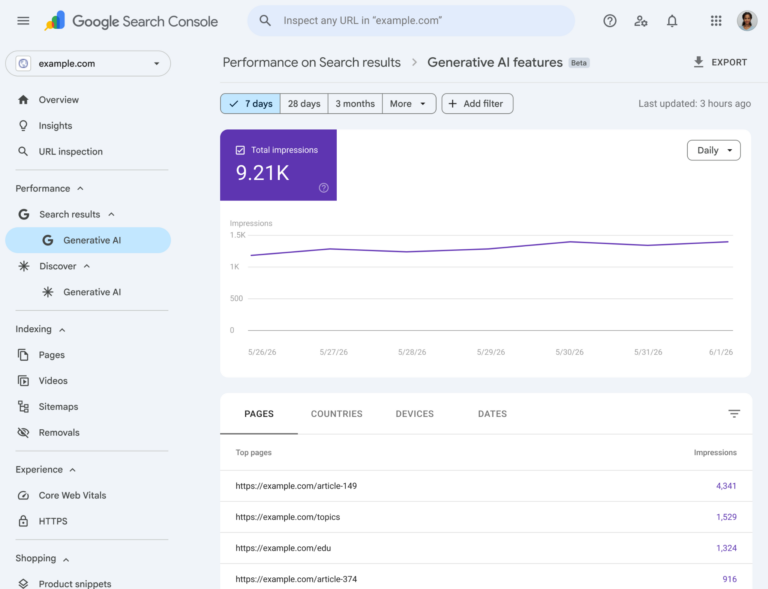

The way people search for information is changing quickly. In the past, users would type a keyword into Google, browse through a list of links, and open several websites before finding the answer they needed.
Today, many people ask questions directly through ChatGPT, Gemini, Perplexity, Microsoft Copilot, or read summarized answers generated through Google AI Overviews. In many cases, users can receive the information they need without visiting every original article.
This shift means publishers, news websites, and content teams need to reconsider the role of an article. A news article should no longer be treated as only a webpage designed for people to read. It should also become a structured and reusable information asset that search engines and AI platforms can discover, understand, extract, summarize, and cite.
One approach gaining attention is Liquid Content. This concept transforms a traditional article from a fixed piece of content into a flexible collection of information that can be adapted, distributed, personalized, and monetized across different platforms.
News Articles Are Not Dead, but They Must Do More
Publishing a long-form article on a website and waiting for users to discover it may no longer be enough. Different audiences prefer to consume information in different ways.
Some people want a quick summary. Others prefer short videos, podcasts, infographics, data tables, or timelines. A professional researcher may need the complete report, while a casual reader may only want the most important points.
For this reason, a single news story should not be viewed as one finished article. It should be treated as a central source of information that can be transformed into multiple formats, such as:
- A complete article on the website
- A short summary with key takeaways
- A video for TikTok, Instagram Reels, or YouTube Shorts
- An infographic explaining statistics or events
- A podcast or audio version
- A timeline of important developments
- A frequently asked questions section
- Social media posts
- An email newsletter
- A push notification
- Structured data for an API or AI platform
The most valuable elements of journalism, including verified facts, expert quotes, statistics, documents, and original reporting, remain important. However, these elements do not need to remain locked inside a single article format.
When information is stored and organized as clearly defined components, it becomes easier to reuse it for different audiences and platforms while maintaining accuracy and consistency.
What Is Liquid Content?
Liquid Content refers to content that is not limited to one fixed presentation. It can change depending on the user’s location, device, interests, available time, and preferred way of consuming information.
For example, a user who is driving may receive a news story as audio. Someone travelling by train may see a short article with an infographic. A subscriber who regularly follows the topic may receive an in-depth analysis through an application or email newsletter.
The main idea is not simply to shorten an existing article. It is to design and organize the information from the beginning so that it can be reused in different formats without losing its original meaning, accuracy, or context.
AI tools can help transform a long report or news article into a briefing, infographic, quiz, podcast, social post, or presentation. However, these outputs still require human review.
This is especially important for content involving medical information, financial data, legal issues, statistics, or direct quotes. AI systems may misunderstand the original material, remove important context, or generate details that were never included in the source.
Move From an Article-First to a Story-First Workflow
Many content teams begin their daily process by asking, “What article should we publish today?”
For AI Search, a better question is, “What is the main story, and what is the best way to communicate it to each audience?”
Some topics work well as detailed articles. Others may be easier to understand through a timeline, comparison table, interactive chart, video demonstration, or question-and-answer format.
A modern content workflow should allow one story to be developed into multiple formats at the same time. Instead of writing a complete article first and repurposing it later, teams can plan several outputs from the beginning.
For example, one interview with an industry expert could produce:
- A complete written article
- Short video clips
- Quote graphics
- A podcast episode
- A list of key takeaways
- An FAQ section
- Several social media posts
This approach reduces duplicated work, keeps information consistent across channels, and increases the chance of reaching audiences on the platforms they already use.
Structure Articles So AI Systems Can Understand Them
Liquid Content depends on clear information architecture. Search engines and Large Language Models need to identify the main facts, understand who provided the information, determine when an event occurred, and recognize which section answers a particular question.
The following practices can make news content easier for both readers and AI systems to understand.
- Present the Main Point Early
Avoid long introductions that force readers and AI systems to search through several paragraphs before finding the answer.
Use an inverted pyramid structure. Start with the most important information, followed by supporting details, background, and additional context.
The opening paragraph should explain what happened, who was involved, where and when it happened, and why the story matters.
- Include Key Takeaways
Long articles should include a short summary near the beginning. A “Key Takeaways” or “What You Need to Know” section allows readers to understand the story within seconds.
It also helps AI systems identify important statements that may be suitable for answering specific user questions.
- Use Clear and Descriptive Subheadings
Avoid vague headings such as “More Information” or “Additional Details.”
Use headings that clearly describe the content below them, such as “How Liquid Content Improves Visibility in AI Search” or “How Publishers Should Structure News Articles.”
Clear subheadings help readers scan the article and allow search engines to understand the relationship between different sections.
- Separate Facts, Quotes, and Opinions
Clearly identify whether a statement is a confirmed fact, information from a report, an expert opinion, or the author’s interpretation.
When including a quote, provide the speaker’s name, position, organization, and relevant context. This reduces the risk of an AI system presenting an opinion as a confirmed fact.
- Use Appropriate Structured Data
News publishers should consider using NewsArticle structured data with important properties such as:
- Headline
- Author
- DatePublished
- DateModified
- Image
- Publisher
Structured data helps search engines understand the type, ownership, publication date, and structure of the content.
However, adding structured data does not guarantee that an article will appear in AI-generated answers. It is one part of making a website easier to process and understand.
- Add Frequently Asked Questions
Before publishing an article, consider which questions readers may ask after reading the main story. Add short, direct answers within the content.
For example, an article about a new regulation should explain when the regulation becomes effective, who will be affected, and what actions people may need to take.
This type of content is helpful for readers and gives AI systems clear answer-sized passages to use when responding to specific questions.
- Build Topic Hubs With Internal Links
Internal links help readers explore a topic in more detail and demonstrate that the website has ongoing expertise in a particular subject.
Instead of publishing isolated articles, create a topic hub that connects breaking news with background explanations, previous developments, data pages, expert analysis, and related FAQs.
This provides stronger context and makes it easier for search engines and AI systems to understand the website’s authority on the subject.
Turn News Data Into Long-Term Assets
News articles often have a short period of peak attention, but the data inside them may remain valuable for years.
Examples include historical prices, sports results, election statistics, medical data, lists of public officials, company announcements, and timelines of major events.
Publishers can transform this information into searchable databases, dashboards, interactive tools, or APIs. This approach is sometimes described as Journalism as a Service, where publishers generate value from their original reporting and specialized datasets through licensing or controlled data access.
For example, a local news publisher may build a regional database containing information about transportation, public services, community events, local businesses, and infrastructure projects.
AI platforms, businesses, researchers, or application developers may be interested in using this information when it is accurate, structured, regularly updated, and supported by clear licensing conditions.
Choose Distribution Channels Based on Audience Behaviour
Not every story needs to appear on every platform. Publishers should study which content formats perform best on each channel.
Sports and entertainment news may perform well through short videos and social platforms. Financial news may be more useful through newsletters, dashboards, and real-time alerts. Detailed investigations may be better suited to long-form articles, podcasts, or membership applications.
Performance measurement should therefore extend beyond page views.
Useful metrics may include:
- Search visibility
- Video engagement
- Social media saves and shares
- Newsletter subscriptions
- Returning visitors
- Application usage
- Brand mentions
- Citations or references from AI platforms
The purpose is to understand how each format contributes to awareness, trust, engagement, and long-term audience value.
Important Risks to Consider
Breaking an article into smaller pieces can create risks. Important context may disappear when a quote, number, or statement is separated from the full story.
Information that is correct in one context may become misleading when presented alone or combined with content from another source.
Personalized content can also create an echo chamber. When people only receive stories that match their interests or existing beliefs, they may be less likely to encounter different viewpoints.
To reduce these risks, every content component should connect back to the original source. It should include a clear publication date, updated date, author, and source attribution where appropriate.
Publishers should also maintain a record of meaningful changes and include human review before publishing content generated or transformed by AI.
Conclusion
Preparing content for AI Search does not mean publishers should stop producing articles or write only for algorithms.
It means creating reliable, clearly structured, original, and reusable information that can be understood by both people and machines.
Instead of treating a news article as the final product, publishers should view it as a central source of information that can be transformed into summaries, videos, audio, infographics, FAQs, newsletters, social posts, databases, dashboards, and APIs.
Organizations that begin structuring their content today will have a better opportunity to be discovered, cited, and trusted by search engines, AI platforms, and readers, regardless of how search behaviour continues to change.
FAQ
- How is Liquid Content different from reposting an article?
Reposting means publishing the same or slightly edited content on another platform. Liquid Content involves organizing information into reusable components and presenting those components in the most suitable format for each audience or platform. The same source material may become a video, podcast, timeline, FAQ, infographic, or API while maintaining the original facts and context.
- Does structured data guarantee that an article will appear in AI Search?
No. Structured data helps search engines understand the article’s type, author, publication date, publisher, and other important elements. However, it does not guarantee inclusion in AI-generated answers. Accuracy, originality, relevance, authority, clarity, and overall content quality remain important factors.
- Can a small website optimize its content for AI Search?
Yes. A small website can begin by placing the main answer near the top, using descriptive subheadings, adding key takeaways, including relevant FAQs, citing reliable sources, creating internal links, and updating articles when information changes. There is no need to build a large or expensive AI system at the beginning.