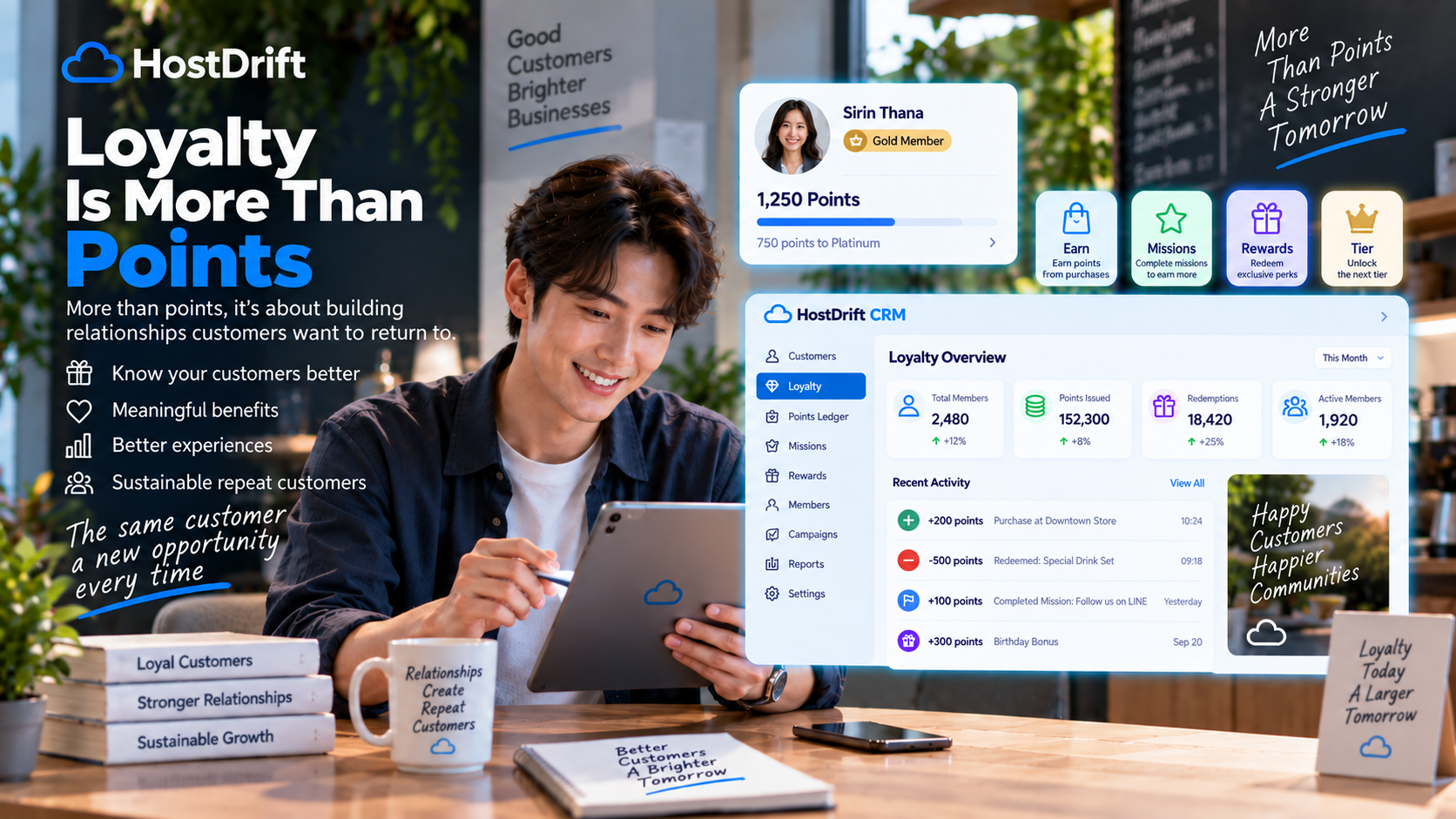
When people talk about loyalty programs, the conversation often begins with questions such as, “How many points should a customer earn per purchase?” or “What rewards should points unlock?” Those questions matter, but to me, points are only one mechanism inside loyalty. Customers do not return simply because the number in a points wallet is getting larger. They return when the business recognizes them, supports them consistently, and gives them a meaningful reason to stay.
After discussing Tasks and Follow-up in the previous article, I want to move to another part of CRM that becomes important once a business knows its customers better: long-term relationship management. I do not think good loyalty starts with giving away the most points. It starts with asking why a customer should want to return and what kind of experience makes the relationship worth continuing.
Points Are a Mechanism, Not the Relationship
Points are useful because they are easy to understand, measurable, and allow businesses to create structured incentives. A customer makes a purchase, earns points, and later redeems them for a benefit. But when that is the entire experience, a loyalty program can become little more than a discount system with an extra number attached.
I therefore separate the point mechanism from customer loyalty. The point mechanism records earning and redemption. Loyalty is the broader result of experience, trust, perceived value, and the reasons a customer chooses the same business again. Points can support that relationship, but they cannot create the entire relationship by themselves.
A Returning Customer Should Not Feel Like a Stranger Every Time
Imagine a small specialty café with regular customers. One customer prefers a particular bean, drinks coffee without sugar, and often visits in the morning. The positive experience does not come only from collecting points. It also comes from the café remembering preferences, responding properly when something goes wrong, and avoiding the need for the customer to explain the same things repeatedly.
CRM can help make that continuity available to the team instead of depending entirely on the same employee being present every day. With appropriate information, staff can understand what the customer has purchased, what they have asked about, which benefits are available, and whether there is an unresolved issue. That context turns loyalty into customer care rather than a points counter.
Rewards Need to Mean Something to the Customer
Giving everyone the same reward can be easy to manage, but it does not mean the benefit is equally valuable to every customer. One person may care about a discount, while another values faster service, early access, or a relevant benefit at the right time.
I believe a loyalty program should design rewards around customer needs and the behavior the business wants to support, rather than only around the cheapest benefit to give away. The system should know what the reward is, when it can be used, what conditions apply, and whether customers actually find it valuable. Issuing a large number of coupons is not the same as creating loyalty.
Earn Rules Should Reflect the Behavior You Want to Encourage
If a business awards points only for purchases, it implicitly says that the customer is valuable only when money changes hands. In some businesses, other actions matter too: completing a profile, making a referral, participating in an activity, returning for periodic service, or doing something that helps the business provide a better experience.
An earn rule should therefore begin with the question, “Which behavior creates value for both the customer and the business?” The points can be designed after that. Some actions should earn points once, some may need limits, and some should not earn points at all if they are too easy to manipulate.
Missions Can Connect Loyalty to the Customer Journey
Missions can extend loyalty beyond a simple earn-on-purchase model by creating activities that fit different stages of the customer journey. A new member might have a mission that helps them understand a service or complete useful profile information. An existing customer might receive an activity related to continued use, while an inactive member might be given a reason to return.
A mission, however, should be understandable and worthwhile. If the system asks customers to complete many actions purely to increase engagement metrics, the numbers may improve while the experience becomes worse. I would use missions when the activity genuinely helps the customer or strengthens the relationship.
A Ledger Matters Because Points Are Benefits That Need an Explanation
Once a business uses points seriously, it needs to answer simple but important questions: Where did these points come from? Why were they added? Why were they deducted? Who adjusted them? A system that stores only the final balance makes those questions difficult to answer.
This is why I value a ledger model that records each change—such as earning, redemption, adjustment, or expiry—so the current balance can be traced back to individual transactions. An audit trail may not be the most visible part of a loyalty program, but it is essential for handling customer benefits transparently and resolving disputes.
Expiry Needs Careful Design
Point expiry can help a business control reward liabilities and encourage members to use their benefits. But complicated rules or unclear communication can make customers feel that the system is designed to take value away from them.
If points expire, I prefer simple rules, visible expiry information, and appropriate advance reminders. The goal should not be for points to disappear quietly. Customers should be able to understand what they have and when they need to use it.
Manual Adjustments Need a Reason and an Audit Trail
Real operations sometimes require people to add or deduct points manually—for example, to correct an incorrect transaction, restore benefits after a service problem, or handle an exceptional case. Manual adjustments are useful, but they also create risk if anybody can change balances without an explanation.
I want adjustments to follow appropriate permissions and retain who made the change, when it happened, why it happened, and how many points changed. If loyalty is part of the customer relationship, the accuracy of the customer’s benefits is part of trust.
Service Recovery May Create More Loyalty Than Extra Points
A customer problem is one of the moments when loyalty is tested most clearly. If a business resolves the issue, takes responsibility, and follows through, the customer may remember that experience more strongly than several previous point-earning transactions.
Points or rewards can be part of service recovery, but they should not replace fixing the problem. If the wrong product was delivered, the first priority is to make the order right—not add points and consider the matter closed. CRM should help the team see unresolved issues before deciding to send another promotion or reward.
Loyalty Needs to Respect Consent and Preferences
Being a member does not mean a business should contact the customer through every available channel. A loyalty platform may know the member’s benefits, activity history, and connected accounts, but communication still needs to respect relevant preferences and consent.
I want Loyalty, CRM, and Consent to keep the meaning of these records distinct. Membership describes the relationship with the program. Consent and preferences help determine how the business should communicate and for what purposes. Combining all of those concepts into a single status might simplify software design, but it would not reflect the real customer relationship.
Do Not Measure Loyalty Only by Point Balance
A customer with many points is not automatically a loyal customer. Someone may have a high balance after one large purchase, while another customer spends less but returns consistently, recommends the business, and maintains an ongoing relationship.
Loyalty measurement should therefore consider several dimensions, such as repeat activity, reward usage, frequency of engagement, or other behaviors relevant to the business. Those conclusions should come from actual data. I would not invent retention percentages or loyalty scores simply to make a dashboard look more impressive.
The Direction of Points & Loyalty in HostDrift CRM
In HostDrift CRM, the Points & Loyalty structure is designed around more than a single balance. The underlying model includes point accounts, a ledger, earn rules, and room to extend into missions and rewards, with customer and loyalty data separated by workspace. The current direction emphasizes traceable point transactions and configurable business rules, while Missions, Rewards, and parts of the member experience continue to be developed in phases.
I do not expect every business to run the same loyalty program or make points the center of the experience. Some may need membership and benefits without a complex points system. Others may use points extensively, while another business may place more emphasis on tiers or service privileges. The important part is having rules that can be explained and that match the real customer journey.
Loyalty Should Give Customers a Reason to Return
Ultimately, loyalty should not make customers feel trapped because unused points are waiting in an account. It should make the relationship with the business worth continuing. Points, rewards, missions, and tiers are tools that can reinforce that relationship, but they cannot fully compensate for poor products, poor service, or inconsistent customer care.
To me, loyalty is more than points. It is recognizing the customer, supporting the relationship consistently, and creating meaningful reasons to come back. When CRM can connect history, benefits, and context, a loyalty program can become more than a reward counter and start functioning as part of real customer relationship management.