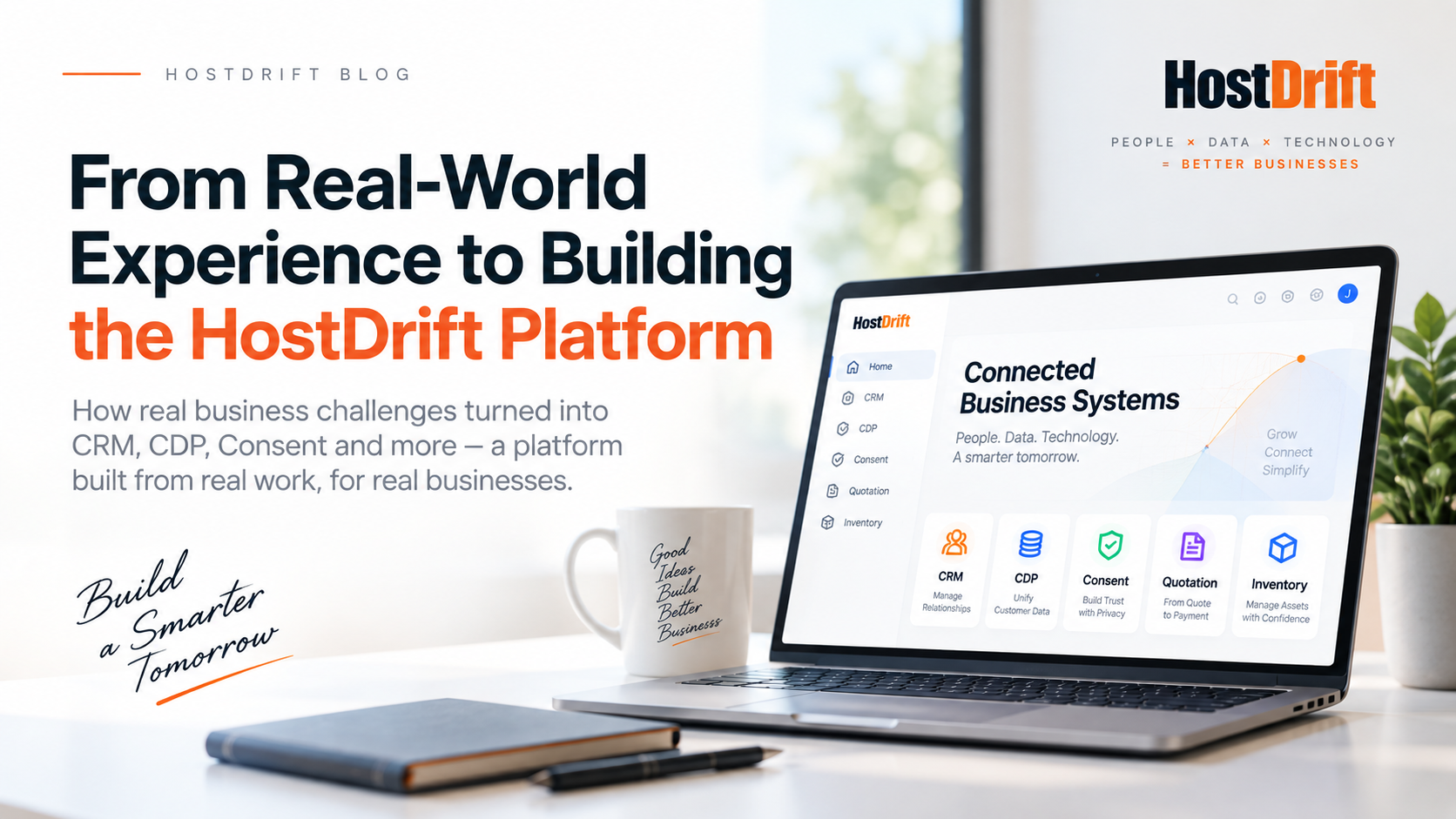

rift, a natural question follows: why build CRM, CDP, Consent, Quotation, and Inventory as separate platforms? They are all business software, so where does one end and another begin? Does a business need to use all of them? My answer is that each platform starts with a different kind of work, and businesses should not need to adopt everything at once.
In the previous article, I explained why I started with operational problems rather than an ambition to build SaaS. This article introduces the products those problems led to, the responsibilities of each, and why I think of them as an ecosystem rather than unrelated applications with the same name. My goal is not to make every product offer the same features. It is to give each a clear purpose and then design the handoffs that genuinely need to happen between them.
An Ecosystem Does Not Mean One Application That Does Everything
I use “HostDrift Ecosystem” to describe a group of focused systems moving in a shared direction. Some support sales and customer service, others organize data or documents, and another helps manage physical items and operational work. Their relationship comes from understanding where one team’s responsibilities meet another’s—not from placing every menu on the same screen.
A conversation, a website interaction, and a quotation may all concern the same customer, but they serve different purposes. Service teams need to know what was discussed. Marketing may need context about an expressed interest. The person preparing a quotation needs accurate details of the proposed work. Shared context can help, but it does not mean every person should see or edit every piece of information.
HostDrift CRM: Where Teams Work with Customers
HostDrift CRM is the platform closest to day-to-day customer operations: receiving conversations, reviewing customer information, following sales opportunities, and managing team tasks. Its capabilities include a Shared Inbox for channels such as LINE OA, Facebook Messenger, and the website, alongside Customer 360°, Lead Pipeline, Tasks, and Points & Loyalty. I want customer information to support ongoing work rather than remain a list of contacts that nobody revisits.
The questions I want CRM to help answer are practical: What did this customer ask about? Who owns the relationship? Where does the opportunity stand, and what should happen next? Someone taking over a conversation should be able to understand the situation without asking the customer to repeat everything. Loyalty tools can extend that relationship, but they still need a thoughtful business approach; adding points alone is not a customer-retention strategy.
HostDrift CDP: Bringing Customer Information into Context
While CRM focuses on what the team is doing with a customer, HostDrift CDP focuses on what information the business has about that customer. The Customer Data Platform brings together customer profiles, behavioral events, and information from connected sources. It also supports segmentation, helping turn relevant data conditions into groups that can inform subsequent work.
A CRM may tell the team when to follow up, while a CDP can add context from activities already captured. However, installing a CDP does not identify every website visitor automatically. Connecting records depends on appropriate identifiers, data quality, and explicit matching rules. I do not want “Customer 360°” to suggest that every piece of information can be combined without limits or uncertainty.
HostDrift Consent: Making Consent Traceable
As customer data becomes more connected, I do not want consent to be treated as a message that appears once on a website and is then forgotten. HostDrift Consent manages consent, cookies, and tags, with records that help trace user choices and related activity. The intention is to give consent information a clear history and a practical role in the way other systems use data.
I also see consent as more specific than a single “allowed” value. A choice for one purpose should not be interpreted as permission for every possible use. That makes this platform relevant both to the website experience and to the way choices are communicated to connected systems. The software is not an automatic guarantee of compliance: the business still needs appropriate purposes, policies, and configuration for its actual operations.
HostDrift Quotation: Managing the Documents Behind a Sale
A customer conversation is only part of a commercial workflow. Teams also need to prepare quotations, issue invoices, send documents, and follow payment status. HostDrift Quotation focuses on that work, including customer and line-item information, Thai and English PDF documents, and supported payment options such as PromptPay and card payments.
I separate Quotation from CRM because relationship information and commercial documents need different kinds of attention. CRM helps people understand the conversation and the next action. Quotation helps them understand what is being offered, in what quantity, and which document was sent to the customer. Keeping those responsibilities distinct also avoids assuming that everyone working in CRM should manage documents or payments.
HostDrift Inventory: Connecting Physical Items with Operational Work
Not every business problem starts with customer data. Products, materials, equipment, and assets also need attention. HostDrift Inventory manages items, categories, quantities, and storage locations, with QR codes and barcodes that help people access information from the physical item. Checklists and tickets extend that into inspections and issue reporting.
For me, inventory is not only about “How many are left?” It is also about “Where is this item?” and “What needs to happen to it?” If someone scans equipment and identifies a problem, the inspection or reported issue should remain associated with that item. This gives the platform an operational purpose beyond treating everything as stock waiting to be sold.
Core and Pay: The Supporting Infrastructure
Operating several platforms introduces shared requirements that do not need a separate solution in every product. HostDrift Core provides a central layer for accounts, organizations, workspaces, product access, and usage credits. HostDrift Pay handles payment infrastructure and transaction status. Their roles help separate account and payment concerns from the core responsibilities of each application.
One distinction is especially useful: platform usage credits in Core are not customer loyalty points in CRM, and neither is the value of a quotation. They are different types of information, even though each involves numbers. Likewise, a central account should not mean unrestricted access to every workspace. Business boundaries and individual permissions remain separate responsibilities that need to be defined.
Following One Customer Journey
Imagine a business that provides website design services. A prospective customer reads the website and chooses their consent preferences. Permitted and configured activity collection provides data context. When the person makes an enquiry, the team handles the conversation and follow-up in CRM, then prepares a quotation in Quotation. Meanwhile, the equipment used to deliver the work may be managed in Inventory. The platforms support the same business, but they do not all need the same information.
This example explains the intended division of responsibilities and integration direction. It is not a claim that every step is already automated in every account. Actual implementation depends on available integrations, enabled settings, and the business workflow. I care more about making each handoff explicit and dependable than drawing connections between every product and assuming that means the integration is complete.
A Business Does Not Need Every Platform on Day One
A team struggling with conversations across several channels might start with CRM. A business working with multiple data sources and audience definitions might prioritize CDP. Repetitive document preparation may point toward Quotation, while difficulty locating equipment may make Inventory the more useful first step. Consent and data-use decisions should be considered alongside the relevant work, rather than postponed until everything has been connected.
I do not want the ecosystem to make people feel that they must adopt and learn every product before receiving value. The starting point should match a real problem, with expansion guided by operational needs. Two systems that a team understands and can maintain may be more useful than several applications whose responsibilities remain unclear.
The Goal Is Continuity, Not the Largest Collection of Software
Viewed together, CRM supports customer operations, CDP organizes customer information and context, Consent manages consent choices, Quotation handles business documents, and Inventory supports physical items and operational work. Core and Pay provide supporting infrastructure. This division also gives me a way to evaluate new features: where should a responsibility belong, and what information actually needs to be shared?
HostDrift remains an ongoing development effort. The direction I want to preserve is simple: keep each platform clear in its purpose and share the information needed for work to continue. If the systems help people avoid starting over whenever a task moves to another screen or another team, that is the kind of connected business ecosystem I want to build—not simply a longer list of products.